4 API
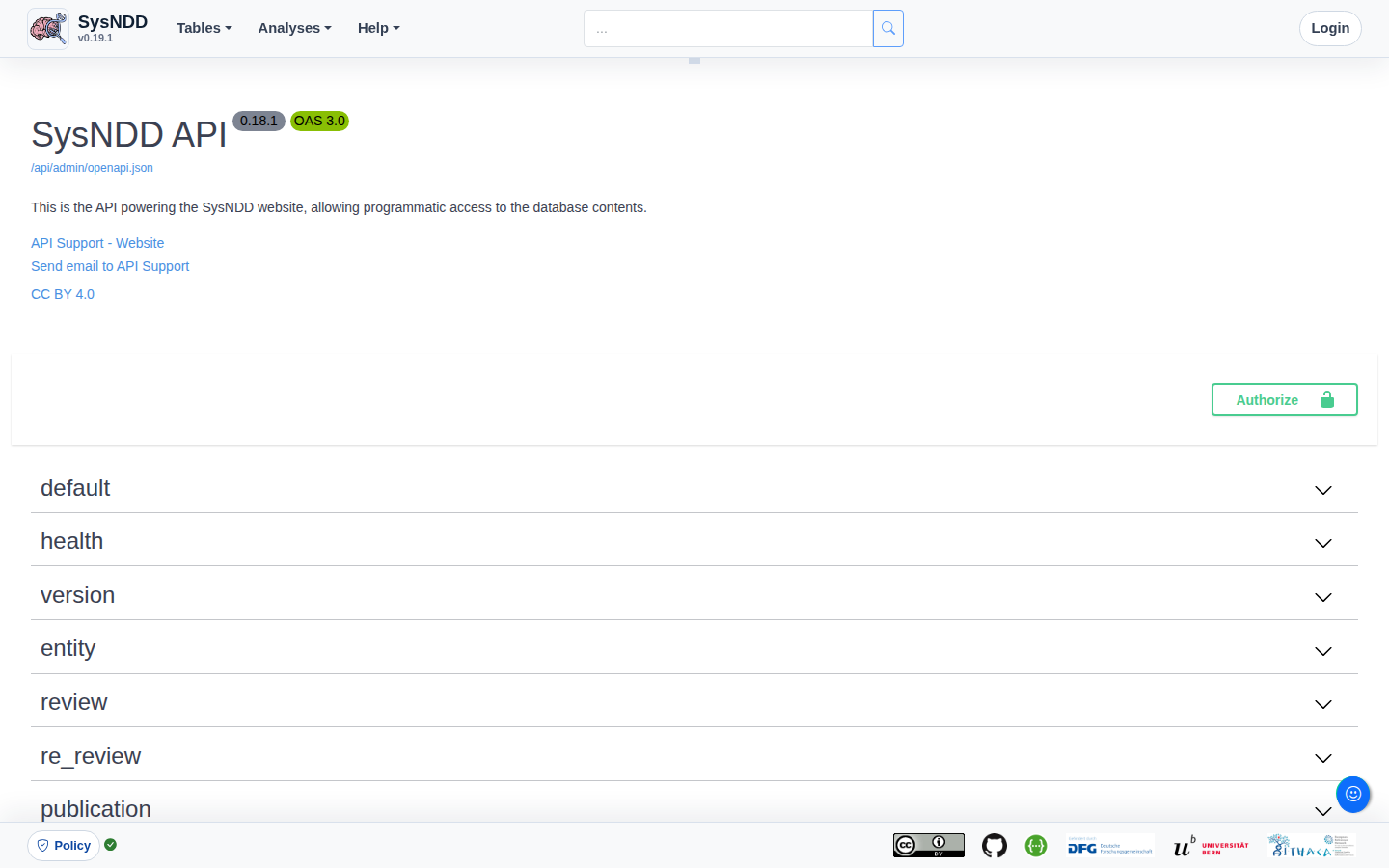
The SysNDD API documentation interface is available from https://sysndd.dbmr.unibe.ch/API. API endpoints are served under the /api path.
The API is written in R using the plumber package and runs in Docker from the repository API image based on rocker/r-ver. In the current Compose deployment, Traefik routes web traffic to the API service under /api.
Runtime and rate-limit behavior can change with deployment configuration. Operator-facing deployment details are maintained in the deployment chapter.
We intend to follow the Swagger/OpenAPI and JSON:API specifications.
4.1 Endpoints
The runtime is composed by api/start_sysndd_api.R, which sources helpers, core modules, services, and endpoint files through the bootstrap layer. Endpoint files are mounted under /api/<subpath> by api/bootstrap/mount_endpoints.R.
Mounted endpoint groups include:
- health and version: service readiness and version discovery
- entity, gene, ontology, phenotype, panels, publication, variant, and list: core data resources
- review, re_review, and status: curation and review workflows
- comparisons and analysis: analysis and NDD gene-list comparison resources
- search, hash, and statistics: lookup, stable links, and summary resources
- user and auth: user account and authentication resources
- about and seo: public content and prerender payload resources
- jobs, logs, admin, llm, backup, and external: authenticated operational resources
The endpoints are documented and can be tested using the Swagger/OpenAPI user interface at https://sysndd.dbmr.unibe.ch/API. Here one can generate cURL requests to use in external software.
4.2 Read-only MCP sidecar
SysNDD can also run an optional Model Context Protocol (MCP) sidecar from api/start_sysndd_mcp.R. The MCP sidecar is a separate R process/container and is not mounted inside the Plumber API process.
MCP v1 is read-only, public and credential-free by design when the opt-in mcp Compose profile is enabled. Production Traefik routes exact JSON-RPC POST /mcp requests to the sidecar and strips the prefix; a narrowly matched GET /mcp with Accept: text/event-stream and exact DELETE /mcp reach the transport and currently return 405 because standalone SSE listening and session termination are not offered. Normal browser GET /mcp navigation continues to render the informational Vue page. Admission controls are one global bucket shared across callers behind the institutional TLS proxy, so one client can temporarily exhaust capacity for everyone; clients should treat 429 as shared-capacity backpressure and retry with backoff. Public reachability does not widen the approved-public data contract described below, and the sidecar has no outbound internet egress.
The pinned mcptools runtime implements the initialize/session-era Streamable HTTP shape. SysNDD’s operational probes negotiate MCP 2025-11-25 and fail if initialize returns a different version; production also accepts 2025-06-18 clients. The latest upstream revision as of 2026-08-27 is 2026-07-28, whose stateless core removes the initialize/session era and adds per-request protocol metadata headers. Issue #629 changes public reachability and edge controls only; it does not claim support for that breaking revision. Upgrade mcptools, the health/smoke clients, and protocol compatibility tests together before advertising 2026-07-28. Current clients should use MCP’s specified backward-compatibility fallback.
Available MCP tools:
search_sysnddget_gene_contextget_genes_contextget_entity_contextget_entities_contextlist_gene_entitiesget_publication_contextget_publications_contextfind_entities_by_phenotypefind_entities_by_diseaseget_sysndd_statsget_sysndd_capabilitiesget_sysndd_analysis_catalogget_gene_research_contextget_nddscore_contextget_curation_comparison_contextget_phenotype_analysis_contextget_gene_network_context
The intended LLM retrieval path is search_sysndd -> get_gene_context -> get_entities_context -> get_publications_context. If a client defers MCP tool schemas, load search_sysndd, get_gene_context, get_genes_context, get_entities_context, get_publications_context, and get_sysndd_capabilities before the first SysNDD call. get_sysndd_capabilities returns in-band guidance for workflows, limits, payload modes, citations, resources, errors, prompt opt-in status, and safety scope. Use get_gene_context(expand = "entities") for a one-call gene + entity detail response when the caller explicitly wants to spend the tokens, get_genes_context for 1-10 genes with per-gene errors, and get_entities_context for 1-20 entity IDs when a gene, disease, or phenotype lookup returns several entities that need detail in one call. SysNDD entities are gene-disease-inheritance curation records, so one gene can have multiple entities. get_gene_context accepts gene; hidden deprecated aliases are not supported. Tool descriptions include short example calls and boolean defaults.
MCP_SCHEMA_VERSION 1.2 adds a bounded analysis scope for gene-centered research context. Start with get_sysndd_analysis_catalog, then use get_gene_research_context with MCP JSON arguments such as {"gene":"HGNC:61","dry_run":true,"response_mode":"compact"} to preflight available sections before focused follow-up calls. The focused tools expose curation comparisons, NDDScore predictions, phenotype analyses, and local gene network context. They do not change curated SysNDD evidence.
Every MCP analysis payload carries a data-class label: curated_sysndd_evidence, curated_derived_analysis, ml_prediction, llm_generated_summary, external_reference_identifier, or operational_metadata. NDDScore is always ml_prediction: model-derived, separate from curated SysNDD evidence, and not an evidence tier. Cached LLM summaries are llm_generated_summary: current validated admin-generated cache entries only. MCP analysis tools do not trigger Gemini/LLM generation, expose prompts or queries, or call live external providers. Stored external IDs may appear only as external_reference_identifier.
Payload controls are part of the MCP contract: response_mode is minimal, compact, standard, full, or analysis-only diagnostics; max_response_chars defaults to auto for large analysis tools; abstract_mode is none, metadata, or excerpt; and synopsis_mode is none, excerpt, or full. minimal defaults to no synopsis and no abstracts. Large analysis responses default to compact mode, include budget metadata, and may report dropped_summary, recovery, and per-section availability. Use dry_run or response_mode = "diagnostics" to inspect likely sections, truncation, and recovery hints before requesting broader context. Other modes default to citation metadata rather than prose; request excerpt or full only when text is needed. Tool results report meta.elapsed_ms. Entity phenotypes are grouped as modifier-keyed HPO ID arrays, and batch/expanded payloads keep schema_version only at the outer envelope. abstract_mode = "metadata" reports abstract_available without abstract_excerpt or abstract_truncated. get_gene_context defaults include_comparisons to false for the cheap path and reports first-page entity metadata in meta.entity_total, meta.entity_returned, meta.entity_has_more, and meta.next_entity_offset. expand = "entities" can return one-call gene plus entity detail, with detailed expansion capped at 20 entity IDs and meta.entity_detail_truncated_by_batch_cap reporting when that cap was applied. get_entities_context defaults dedupe_publications to true, moving shared publication objects to a top-level publications list and leaving per-entity publication_refs.
Publication outputs include recommended_citation, publication_date_sysndd_record, publication_date_confidence, and optional abstract fields controlled by abstract_mode; linked entity review dates are reported separately as sysndd_curation_date. recommended_citation omits the year when the publication date is unverified. Historical rows remain unverified until the one-off PubMed backfill is applied.
MCP prompts are disabled by default. The MCP and Claude Code documentation model prompts as user-controlled slash-command templates, not automatically discovered LLM workflows. Keep the agent-discoverable workflows in tools, resources, and get_sysndd_capabilities; set MCP_ENABLE_PROMPTS=true only for deployments that intentionally want slash commands such as sysndd_gene_evidence_summary, sysndd_entity_evidence_brief, sysndd_publication_citation_pack, and sysndd_phenotype_entity_discovery. Prompts provide workflow instructions only; they do not perform generation, writes, or external calls.
The static sysndd://schema/overview and sysndd://schema/tool-guide resources are available through resources/list and resources/read and document schema and tool usage as distinct resources. Record-level sysndd://gene, sysndd://entity, and sysndd://publication URIs in tool payloads are stable identifiers; v1 retrieval remains tool-based rather than parameterized resource templates.
The MCP service exposes only approved-public data: active records represented by ndd_entity_view and review-derived evidence from primary approved reviews (is_primary = 1 and review_approved = 1). It must not write to the database, call write routes, execute raw SQL/R, expose admin/user/log/job data, expose draft reviews or re-review workflows, call live external providers, or trigger Gemini/LLM generation.
The Phase 0 transport spike proved mcptools HTTP initialize -> tools/list -> tools/call, GET 405, no required session header, and JSON-serialized text tool output. MCP v1 therefore keeps stable JSON text with schema_version as the compatibility contract. The sidecar patches mcptools initialize metadata, static resources, optional prompts, read-only tool annotations, output schemas, and recoverable tool errors so clients receive SysNDD-specific workflow instructions and can self-correct invalid inputs. Known tool validation errors return a JSON payload with error.code and isError = true, not JSON-RPC -32603.
The Docker healthcheck is deliberately lighter than the smoke probe: it only verifies initialize and tools/list against the local MCP endpoint. Use make test-mcp-smoke for end-to-end tool behavior that depends on approved public DB content.
4.3 Usage policy
The SysNDD API powers the web tool for everyday users. We also provide the SysNDD API free to allow users to use the SysNDD data and build on it by creating software or services that connect to our platform.
Usage requirements:
- optimize your requests to stay within deployment limits
- be sensible about reusing data (e.g., store your requests until data is updated on our server)
- use pagination where possible instead of requesting large data chunks (e.g., restrict usage of “all” option in large, potentially blocking list endpoints like “entity” and “gene”)
- if you require more API resources please get in contact
Updates and disclaimer:
- We provide the SysNDD API as is.
- Due to the current development status (version 0.X.Y) we may update or modify the API any time. These changes may affect your use of the API or the way your integration interacts with the API.
4.4 Authentication and authorization
The SysNDD API uses JSON Web Tokens (JWT) to implement stateless authentication and authorization.
For testing, an API user can manually request a token by entering login credentials at the api/auth/authenticate endpoint:
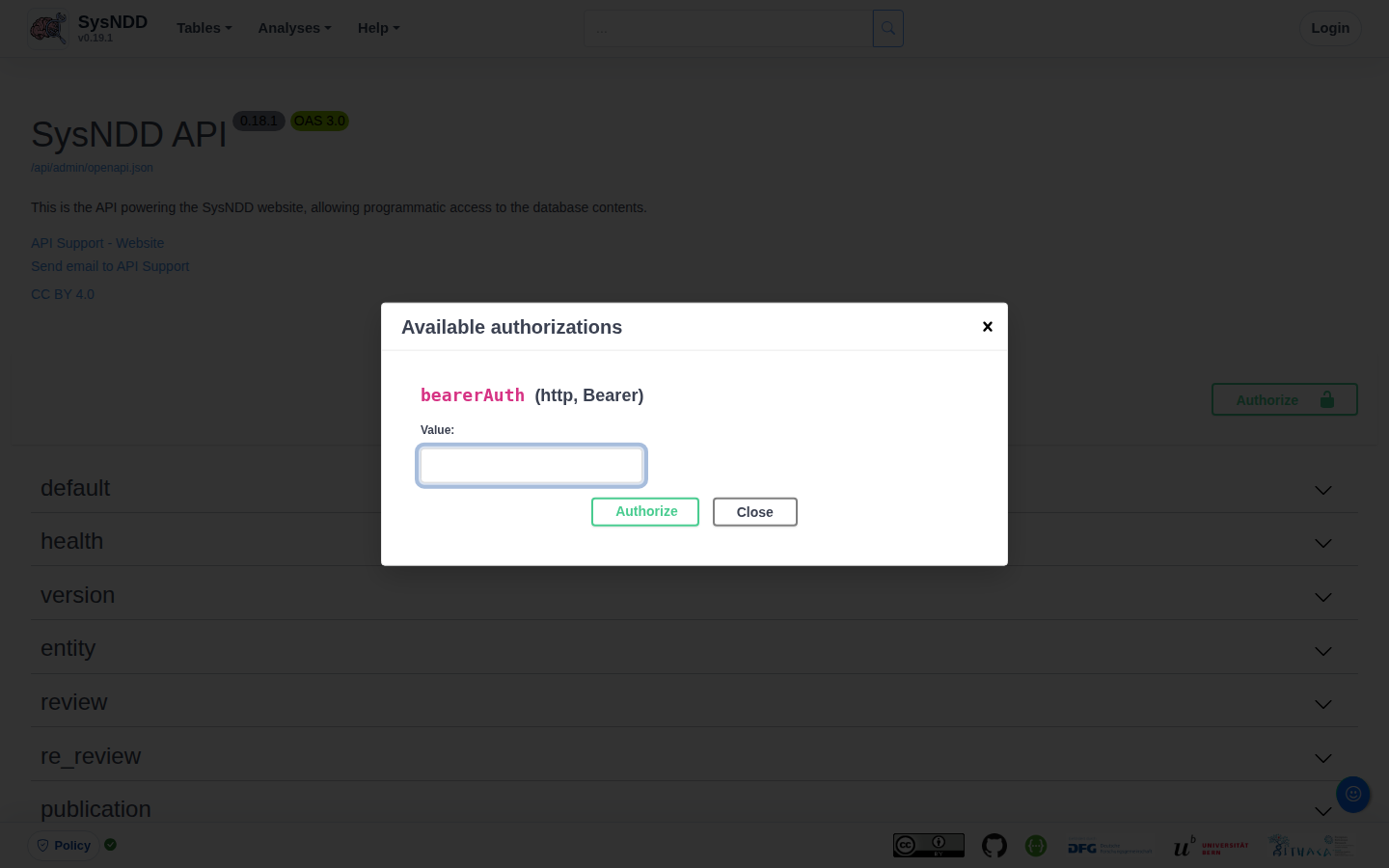
The endpoint returns a JWT. Copy the Bearer token into the OpenAPI/Swagger authorization modal, which opens after clicking the “Authorize” button in the API documentation interface. After authorization, the user can access endpoints requiring user rights until the token expires.
The token is valid for 60 minutes. It can be refreshed using the endpoint “api/auth/refresh”.